
LVL Scaffold Boards vs Solid Timber: What UAE Sites Check Before They Accept Them

A scaffold board is the one piece of timber on site that people stand on at height, so it gets checked differently from everything else. Safety officers look at the markings, the end bands, the condition of the board and the standard it was made to. If any of those is wrong, the board doesn’t go up.
Timber scaffold boards on UAE sites fall into two groups: solid timber boards made to the British Standard BS 2482, and LVL scaffold boards made from laminated veneer lumber, which are often proof-tested to US OSHA requirements and sometimes made to BS 2482 as well. Here is how they differ and what local codes expect.
BS 2482 solid timber boards
BS 2482 is the British Standard for timber scaffold boards, and it is the reference most UAE contractors write into their specifications. Boards are typically 225 mm wide and 38 mm thick, cut from graded softwood such as European whitewood. Each board is graded and then fitted with metal end bands showing the standard, a grading mark and the maximum span the board can be used at.
That end band matters. To an inspector, a board without a readable band is just a plank.
LVL scaffold boards
LVL boards are made by gluing many thin veneers together with a weatherproof glue, so knots and weak spots are spread through the board instead of sitting in one place. The result is a board whose strength is much more predictable from one piece to the next.
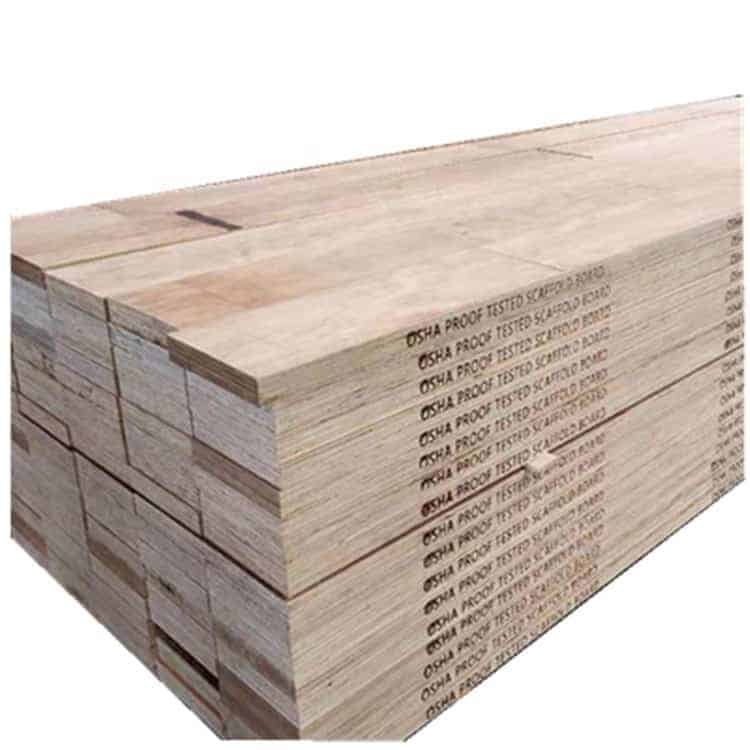
You will often see LVL boards sold as “OSHA approved”. Strictly speaking, there is no such thing, because OSHA doesn’t approve products. What a good LVL plank has is an individual proof test against OSHA deflection limits, with that embossed on the board. Some LVL boards, such as those made from Kerto LVL, are also manufactured and certified to BS 2482.
LVL vs solid timber at a glance
| Solid timber (BS 2482) | LVL | |
| Material | One piece of graded softwood | Many thin veneers glued together |
| Strength from board to board | Varies with knots and grain | Very consistent |
| Marking | End bands with BS 2482 and maximum span | Embossed proof-test mark; BS 2482 marking on compliant boards |
| Splitting | Prone to end splits as it dries out | Less prone to splitting |
Neither type is “the safe one” by default. A properly graded and banded timber board is fully acceptable. A cheap LVL board with no proof-test record isn’t.
What UAE codes say about scaffold boards
In Dubai, scaffolding falls under Chapter 8 of Dubai Municipality’s Code of Construction Safety Practice. It requires every scaffold and its components to carry at least four times the maximum intended load, and supported and suspended scaffolds must be inspected by a third party approved by Dubai Municipality.
In Abu Dhabi, Code of Practice 26.0 on scaffolding, part of the ADOSH-SF framework (previously known as OSHAD), goes into more detail on boards. Platform boards must be slip-resistant, free of cracks and splits, of uniform thickness and fixed so they can’t be kicked off or lifted. Overhang past a support is capped at 150 mm or four times the board thickness, which for a standard 38 mm board comes to about the same figure. Working platforms must be at least 800 mm wide (four boards) for people only, or 1.0 m wide (five boards) when materials are kept on them as well.
The same code says boards must not be painted or treated in any way that could hide defects, and must not be used as crawling boards or for shuttering. That last rule is worth repeating on site. A scaffold board that has spent a week as formwork is no longer a scaffold board.
Free zones and large developers often add their own HSE rules on top of these, so check the project specification before you order.
Which should you buy?
For a contractor building a fleet of boards that will be used for years, LVL often makes sense. Consistent strength and less splitting should mean fewer boards scrapped at inspection. For shorter jobs, or sites where the specification asks for BS 2482 timber boards, graded boards from a whitewood supplier in Dubai are the straightforward choice.
Whatever you buy, the Gulf climate is hard on timber, and solid boards left in direct sun can dry out and split at the ends. Abu Dhabi’s code asks for boards to be cleaned after use and stacked flat and raised off the ground. Keeping them in the shade helps too, and check the end bands after every job.
A quick check before boards go up
- End band present, tight and readable, showing the standard and the maximum span
- For LVL, a proof-test mark embossed on the board
- No splits beyond the allowed limit, no rot and no cuts across the width
- No paint or coating hiding the surface
- Never used for shuttering or as a crawling board
- Correct overhang at the supports and enough boards for the platform width
Frequently asked questions
Is there an OSHA-approved scaffold plank?
No. OSHA doesn’t approve individual products. Look for LVL planks that are individually proof-tested to OSHA deflection limits and embossed to show it.
What size is a standard scaffold board?
BS 2482 boards are typically 225 mm wide and 38 mm thick. UAE suppliers commonly stock lengths up to about 3.9 m.
Can scaffold boards be used as formwork?
They shouldn’t be. Abu Dhabi’s scaffolding code of practice (CoP 26.0) says scaffold boards must not be used for shuttering.
Are LVL boards stronger than timber boards?
Not in every case. What LVL offers is consistency, which makes its performance easier to rely on.
Timber Valley supplies LVL boards and scaffolding boards to contractors across the UAE. Send us your project’s specification and we’ll match the board to it. See the full range from your LVL board supplier in Dubai.